Holiday Cheer and Craft Beer Design Review
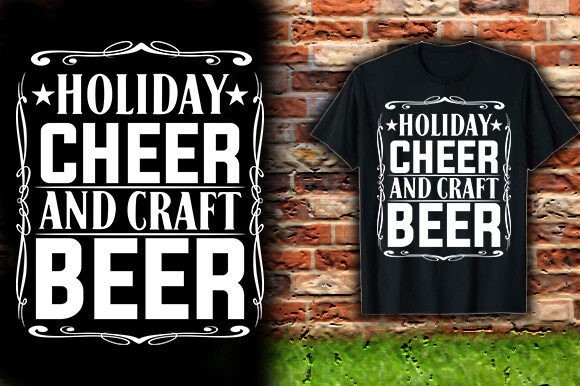
When I first opened HOLIDAY CHEER and CRAFT BEER TSHIRT DESI, I immediately pictured a cozy winter market stall, someone holding a frothy pint with a Santa hat perched on the glass, warm string lights overhead. This design leans into that comfortable, unpretentious holiday feeling. It does not scream for attention, but it has an approachable charm that makes it a smart pick for handmade product sellers who want something that feels both seasonal and personality-driven. The mood sits right at the intersection of festive and casual, and I could easily see customers gravitating toward it on a sweatshirt at a craft fair or on a canvas tote bag given as a last-minute but thoughtful holiday gift.
The layout generally reads well from a distance. There is a balance between bold seasonal motifs and craft beer elements that keeps the design from feeling too generic. It does not rely on tiny intricate flourishes that vanish under thread, which is a relief for anyone who has wrestled with microscopic detail in a machine embroidery design. The personality feels relaxed, a little playful, and completely wearable. This is the kind of graphic that makes a stranger at a party nod and say, "Where did you get that?"
Where the Design Finds Its Real Purpose
Thinking through the practical applications, HOLIDAY CHEER and CRAFT BEER TSHIRT DESI naturally fits a few key product categories. A heavyweight cotton apron with this design stitched across the chest feels like an instant seller for a small shop specializing in host and hostess gifts. A structured canvas tote bag would carry the design beautifully, especially with a solid fill stitch background that gives the artwork a slightly raised, substantial hand feel. I also see strong potential on a unisex crewneck sweatshirt, where the design can be placed center front at a generous size without overwhelming the garment.
For Etsy sellers or craft business owners who focus on personalized gifts, this design offers a quick path to a finished product that does not require heavy customization. The theme is broad enough to work for coworkers, friends, siblings, dads, and that one neighbor who always brings a six-pack of something interesting to the holiday block party. It is the kind of embroidered patch concept that could move well at a winter market, pinned to a display board or already heat-pressed onto a beanie. I have learned over the years that designs bridging two specific interests, in this case holiday cheer and craft beer, tend to attract buyers who feel seen by the niche.
Thinking About Fabric and Surface Challenges
Before committing to a production run, I always run through the tougher scenarios. A design like this would need extra care on thin or stretchy fabric. Lightweight t-shirts, for example, might pucker if the stitch density is too high, especially around any lettering or small decorative accents. Using a quality cutaway stabilizer and possibly a water-soluble topping becomes important on something like a heathered tri-blend tee. For a kitchen towel, where the texture is looser and the weave more visible, I would want to test how the fill stitch interacts with the fabric. A dense fill on an absorbent towel can make the design feel stiff and scratchy, so a running stitch approach or an open fill might serve the product better.
Dark fabric introduces another variable. If the design relies on deep reds, rich browns, and amber tones for the beer elements, those colors can lose contrast on a black or charcoal background. Testing the design on both a natural cotton canvas and a dark heather gray sweatshirt would be my first move. I have seen too many hopeful sellers skip this step and end up with a finished product that looks muddy from arm's length. Thread color contrast makes or breaks the visual appeal more than any other single factor.
Curved surfaces like caps and hats add a different kind of complexity. The flat vector shapes in the original EPS and SVG files might need slight distortion adjustments when mapped onto a structured cap front. Small text or delicate outlined shapes near the edges of the cap frame can get lost in the seam or curve away from view. I would recommend testing placement carefully on a cap hoop before running a full batch, especially if you plan to offer matching hats and shirts as a bundled product set.
Translating Vector Shapes Into Stitch Quality
Because HOLIDAY CHEER and CRAFT BEER TSHIRT DESI is built entirely from resizable vector shapes, the foundation for a clean embroidery file is solid. Vector artwork typically digitizes more predictably than raster images, especially when you need to scale the design up for a jacket back or down for a chest pocket placement. The fully editable nature of the supplied EPS 10 and SVG files means I can separate elements, adjust for satin stitch outlines, and assign different stitch types without fighting messy anchor points. This matters enormously in a commercial embroidery setting where time lost on cleanup directly eats into your profit margin.
One thing I would watch is the level of fine detail in smaller decorative accents. If there are tiny holly berries or delicate hop cone shapes, reducing them too small for a left-chest placement could result in thread breaks, needle gumming, or a blob of stitches that no longer reads as the intended shape. My habit is to check every element at the intended finished size by printing a black and white paper mockup and pinning it to the actual garment. If a detail disappears in the paper print, it will certainly disappear in thread. You can then simplify or omit it before digitizing, which saves frustration and wasted stabilizer.
Customer Reaction, Product Value, and Brand Trust
From a handmade product standpoint, this design has the kind of specific seasonal appeal that builds immediate buyer trust when executed well. A customer browsing an Etsy shop for an embroidered holiday sweatshirt is not just buying a piece of clothing. They are buying the feeling of walking into a holiday party wearing something that expresses their personality without being over-the-top. If the stitching looks crisp, the design sits flat against the fabric, and the fabric itself feels substantial, the perceived value of the finished product rises noticeably. A clean vector-based design like this makes that consistency easier to achieve across multiple products.
Brand consistency across a small product line also benefits from the easy color modification mentioned in the product description. If a small business owner wants to offer the same design in different thread palettes, one for a traditional red and green holiday look and another in muted winter neutrals, the editable vector layers make that straightforward. That flexibility adds real commercial value, especially when preparing a seasonal collection where color cohesion across several items signals a professional, curated brand rather than a random assortment.
Giftability matters too. A pillow cover with an embroidered craft beer and holiday design, packaged simply with a kraft paper insert, feels considered and personal. It targets a specific person. That is what buyers in the handmade marketplace are searching for, something that feels made for them, not mass-produced. A cleanly stitched design on a quality blank turns a simple graphic into a product that earns repeat customers and word-of-mouth referrals.
A Real Scenario That Tests the Design
Let me walk through a scenario I actually considered while reviewing this design. I pictured a small batch of heavyweight canvas tote bags, each with the design embroidered in the lower corner, paired with a bottle of local craft beer as a customer appreciation gift. The bags would be natural off-white with deep evergreen and copper thread tones for a subtle, elevated look. Before committing, I would load the vector file, check the smallest elements at the exact tote bag imprint size, confirm that the stitch density works on a textured canvas without puckering, and run a test stitch on a scrap of the same fabric. Only after that test would I feel confident producing twenty or thirty units for a client order or shop listing.
In that scenario, the design's vector construction makes a tangible difference. I can quickly isolate the beer glass and adjust its fill color to match a copper metallic thread, while leaving the holiday type in a matte green. The ability to modify and change colors without degrading the artwork is not just a convenience, it is a selling point for anyone offering custom variations. A client might request the design in their brewery's brand colors, and with this file format, that request becomes a five-minute adjustment rather than a complete redesign.
Practical Embroidery Designer Notes
There are a few non-negotiable habits I recommend when working with a design like HOLIDAY CHEER and CRAFT BEER TSHIRT DESI. First, always test on a scrap of the actual fabric you plan to sell, not just on a piece of muslin you keep near the machine. Fabric weight, stretch, and texture influence the final appearance more than many beginners realize. Second, check your thread color choices under the lighting where buyers will see the product. Craft fair booth lighting is unforgiving, and colors that look balanced in your studio can shift dramatically under fluorescent or outdoor light.
Review the stitch density in your digitized version. Vector shapes do not automatically translate to appropriately dense embroidery without thoughtful settings. A shape that looks ideal on screen might stitch out far too heavy, creating a bulletproof patch that does not drape or breathe. This is especially important for baby clothes or lightweight fashion blanks where stiff embroidery can ruin the garment's comfort. Use a fill stitch that leaves enough breathing room, and consider running stitch shading if you want a softer, more vintage look that also reduces stitch count.
Also confirm whether you have the appropriate license for commercial use before selling finished products featuring the design. The product description highlights that the graphics are suitable for printing on a wide range of items, but always verify whether that extends to embroidery digitization and the sale of embroidered physical goods. This small step protects your business and keeps your shop in good standing.
Final Thoughts Before You Press Start
Overall, HOLIDAY CHEER and CRAFT BEER TSHIRT DESI brings a practical, charming, and commercially viable option to the table for crafters and small shops. The vector file quality, the ease of color editing, and the versatile theme give it strong legs across multiple product types. It does not promise to be the most intricate or technically demanding embroidery file available, and that is precisely its strength. It feels designed for makers who need a reliable, reproducible design that looks professional and connects with real buyers. Take the time to test it on your chosen fabric, nail the thread palette, and simplify any details that feel too delicate for thread. If you treat it with the respect any good embroidery design deserves, it will reward you with a finished product that sells itself during the holiday season and beyond.