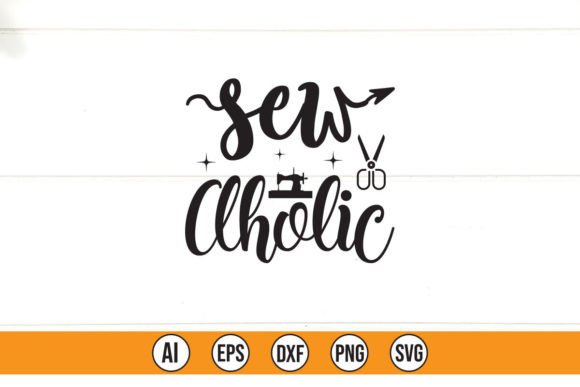
Sew Aholic Graphics & T-Shirt Designs for Branding
Opening the File: First Impressions of Sew Aholic
Every seasoned brand designer knows the feeling of opening a new graphic design asset and immediately imagining where it belongs. With Sew Aholic, the first impression lands somewhere between playful nostalgia and handmade warmth. The visual language is friendly without being childish, decorative without being overwhelming, and crafted with a clear understanding of what makes a design asset actually usable for small business branding. This is not one of those collections that looks beautiful on a screen but crumbles the moment you drop it onto a product label or packaging mockup.
The mood it creates leans toward the handmade, artisanal, and approachable side of brand personality. Depending on the specific elements you pull into a project, Sew Aholic can tilt more feminine and boutique-ready, or more rustic and down-to-earth. There is a softness in the linework that reminds me of hand-stitched details, which makes the name feel earned rather than forced. For a designer building a brand around tactile experiences—textiles, paper goods, baked treats, handmade skincare—this collection offers a consistent visual thread.
What Type of Business Actually Benefits From This Asset
When I evaluate a design asset for client work, the first filter is always fit. Sew Aholic fits best with businesses where warmth, care, and craftsmanship sit at the core of the brand story. Think about a small bakery that hand-pipes every cupcake, a children's clothing line sewn in limited batches, a candle brand pouring soy wax in a studio kitchen, or a florist wrapping bouquets in kraft paper. The graphic elements here do not scream for attention. They support the product, which is exactly what professional branding should do.
For T-Shirt Designs, the same principle applies. The graphics work on apparel when the brand identity calls for something that feels personal and intentional rather than mass-produced. A local coffee shop selling branded merchandise, a handmade soap company offering crewneck tees, or a boutique stationery shop expanding into wearable goods—these are the scenarios where Sew Aholic shines on fabric. It translates the softness of the original artwork into something people want to wear.
Branding a Real Local Business: The Case Study That Sold Me
To test this collection properly, I framed it around a hypothetical but realistic project: a handmade children's clothing boutique opening in a small downtown strip. The owner needed everything from product hang tags and thank-you cards to social media graphics and a small run of branded T-shirts for market events. Budget was tight, turnaround was fast, and the visual identity needed to feel coherent across paper, fabric, and screens.
Sew Aholic became the connective tissue. The editable vector files meant I could adapt individual graphic elements to different formats without losing quality. A decorative border from one file became the frame for a thank-you card. A small illustrative motif scaled up for a tote bag mockup. A repeating pattern element worked as a subtle background on price tags. The cohesion across touchpoints is what separates a scattered brand from a memorable one, and this collection made that cohesion achievable in hours rather than days.
Practical Applications Across Packaging and Promotional Material
Let me walk through the real-world uses where Sew Aholic proves its value. These are not theoretical applications. Every one of them came up during the case study and every one of them is relevant for small business owners who need design assets to work hard across multiple formats.
- Product labels and hang tags: The decorative elements add charm without crowding essential product information. I tested several variations on kraft paper mockups and the results looked intentionally designed rather than templated.
- Thank-you cards and packaging inserts: Small businesses live and die by the unboxing experience. A well-placed graphic from this set transforms a plain card into something that reinforces brand identity and encourages repeat purchases.
- Social media graphics and promotional banners: The PNG files with transparent backgrounds drop cleanly onto photo backgrounds, flat color fields, and textured overlays. No awkward white edges, no tedious background removal.
- Menu graphics and price lists: For a café or bakery, the softer design elements frame pricing information without distracting from it. Visual hierarchy stays intact.
- T-shirt and merchandise graphics: Scaled properly on apparel mockups, the designs retain their personality. The SVG and DXF formats make the transition from paper to fabric smoother than raster-only alternatives.
- Website banners and email headers: Consistent visual elements across digital touchpoints reinforce brand recognition. Customers who see the same design language on Instagram, a website banner, and a product package build trust faster.
Where This Design Asset Performs at Its Best
After testing across multiple use cases, I can confidently say Sew Aholic excels in product packaging accents, hero graphics for social media, decorative brand elements on printed collateral, and seasonal promotional visuals. The collection carries enough variety to support a full brand identity system without feeling repetitive. For boutique visuals—especially those that need to photograph well on flat-lay product shots—the graphics hold their own beside physical products without overpowering them.
One pleasant surprise was how well the elements worked on small-format printed pieces. Not every design asset scales down gracefully. These do. On a two-inch hang tag, the details remain legible and the decorative intent stays clear. That matters enormously for businesses selling small-batch goods where packaging real estate is limited but the expectation for quality is high.
When to Exercise Restraint With Sew Aholic
No design asset is universal, and responsible brand designers identify limitations before they become problems. Here is where I would use Sew Aholic carefully or not at all:
- Formal corporate branding: The handcrafted warmth that makes this collection special works against it in a law firm, financial consultancy, or corporate B2B context. The aesthetic signals approachability, not authority.
- Crowded product packaging: If a label already carries ingredient lists, nutritional panels, barcodes, and multiple certifications, adding decorative graphics on top creates visual chaos. Choose one hero element and give it breathing room.
- Luxury minimalist brands: High-end skincare or jewelry brands that rely on negative space and restraint may find these graphics too expressive. The design language leans friendly, not exclusive.
- Low-contrast backgrounds: Some of the finer linework can disappear on pale or textured surfaces. Always test print proofs before committing to a full production run.
- Legal or compliance-heavy areas: Keep decorative elements away from allergen warnings, ingredient disclosures, and regulatory text. Clarity must win over charm in those zones.
A Designer's Testing Checklist Before Client Delivery
Before I hand off any project using Sew Aholic, I run through a standard checklist that has saved me from expensive reprints and awkward client conversations. I recommend every small business owner and designer do the same.
- Print a physical proof at actual size. Screen colors lie. Paper reveals the truth about line weight, contrast, and placement.
- Test in black and white. If the graphic loses all meaning without color, it may not be versatile enough for your full branding system.
- Preview on multiple backgrounds. The transparent PNGs are excellent for this. Drop them on white, kraft, black, and colored surfaces to check legibility.
- Pair with your brand fonts. Test the graphics beside a serif font, a sans serif font, a script font, a handwritten font, and a display font. Some combinations will feel natural and others will fight. Document what works.
- Check competitor packaging. If three other brands on the same shelf use similar decorative elements, you have a differentiation problem. Sew Aholic gives you editable flexibility to tweak colors and compositions until the result feels unique.
- Inspect vector editability. The AI, EPS, and SVG files should open cleanly in your design software. Nodes should be manageable. Layers should be organized. If you need to recolor or resize, it should take minutes, not hours.
- Review the PNG resolution. At 300 dpi, the files hold up for print. But always confirm dimensions before scaling up for large-format use.
- Confirm commercial licensing. Before using any design asset for client work, business branding, or physical product sales, verify that the commercial license covers your intended use. This is not optional.
What the File Format Variety Actually Means for Workflow
The package includes editable files in multiple formats, and the practical benefit goes beyond a checklist of acronyms. Having AI and EPS files means you can open the graphics in Adobe Illustrator and customize colors, scale infinitely, and isolate individual elements without quality loss. The SVG format is particularly valuable for web and digital applications where fast-loading, scalable graphics matter. DXF support opens the door for cutting machine projects—useful for businesses that create physical tags, decals, or apparel embellishments. The PNG files with transparent backgrounds at 300 dpi are ready for immediate use in Canva, Photoshop, or any design platform that accepts raster images. The JPG versions with high-quality mockups let you preview the designs in realistic product settings without building scenes from scratch.
For a small business owner who does not have a dedicated design team, the color-changeable feature across all files is a significant time-saver. You can match the graphics to existing brand colors without rebuilding anything from the ground up. Consistency across packaging, social media, and promotional materials becomes achievable with basic design tools and a clear color palette.
How Sew Aholic Strengthens Customer Perception and Brand Trust
Here is something marketplace descriptions rarely mention: the quality of your graphic assets directly impacts customer trust. A product label that looks thoughtfully designed signals that the product inside was made with equal care. A social media graphic that feels polished and intentional encourages engagement. Thank-you cards that carry a consistent design language turn first-time buyers into repeat customers who remember the brand experience.
Sew Aholic supports this because it gives small businesses visual consistency without requiring a full-time designer. The elements feel cohesive across formats. A customer who sees a decorated price tag at a market booth, then visits the website and recognizes the same visual style, then receives a package with matching thank-you card graphics, experiences a seamless brand journey. That kind of repetition builds recognition, and recognition builds trust. Trust builds sales. The chain starts with choosing design assets that can support every touchpoint without breaking.
Final Practical Notes for the Small Business Toolkit
If Sew Aholic aligns with your brand personality, treat it as a foundational graphic design asset rather than a one-time decoration. Build it into your packaging templates, your social media templates, and your printed collateral templates. The consistency will compound. Test it on real packaging mockups before committing to print runs. Compare it beside your competitors. Try it in seasonal campaigns—the handcrafted quality suits holiday packaging, market season promotions, and limited-edition product launches especially well.
For local business owners, boutique founders, handmade sellers, and marketing teams who need professional branding without the overhead of custom illustration from scratch, Sew Aholic offers a practical bridge between DIY design and agency-level polish. The fact that it comes with high-quality mockups, transparent backgrounds, and full vector editability means you are not just buying pretty pictures. You are buying usable, adaptable design assets that can grow with your business across product labels, T-shirt designs, promotional graphics, and beyond.